

Episode 89, 12 min listen
Whether or not you follow State of Inclusion, you know that 2025 was a difficult year for equity and inclusion, and 2026 is already shaping up to be even more difficult in so many ways. In this episode, we’ll take a moment to reflect on our 2025 discussions and look ahead to our podcast in 2026. Now is the time to lean in, not back.
AUDIO PLAYER
You can access this episode wherever you listen to podcasts via our pod.link.
FULL TRANSCRIPT
-Looking Back at 2025
If you are listening to this podcast, I’m sure I don’t have to tell you just how difficult 2025 was and how 2026 is shaping up to be even more difficult in so many ways. In this episode, we’ll take a moment to reflect on our discussions from 2025 and look ahead for our podcast in 2026.
Last year in January, it seemed perfectly normal to share about the class that Emma Winiski and I did at the Facing Race Conference in the fall of 2024. Where we talked about our Six Practices for Building a More Inclusive Community. We highlighted a clear example of those practices in Oklahoma City Government. That was the fall of 2024, when the conference was held, there were thousands of folks there from city and county governments, consultants, activists. We were all still freely talking about advancing the work of diversity, equity, and inclusion in city and county government. Storm clouds were brewing for sure, but everyone was still free to speak, to share, to encourage. It is shocking to think about how much has changed since then and just how quickly.
By the time I posted the May episode How are you doing: Lessons from the field, people were already fearful to speak up and speak out on the subject of community equity and inclusion. I had some brave folks share their voice for that episode, but I also had people decline to speak publicly in order to try to protect their organization – funding, grants, fear of retribution. It has only gotten so much worse since then.
In February and March, my episodes touched on civic engagement as a way to build community. Discussions with Leslie Garvin and Michael Cooper reminded us of the importance of community and of civic engagement. Both Leslie and Michael described community as being, in Leslie’s words,
“Those places and spaces where you find belonging and connection.”
Michael went a little bit further to tell us that, for him
“Community building is about just giving people spaces to find people who care about them, to find connection, and to find purpose outside of themselves.”
-Reflections
As you’re listening to this, you might even hit pause for a second and ask yourself a few questions,
· What does community mean to you?
· Where do you find community?
· How do you experience community?
· How do you build community?
You know, Michael also shared a personal story of how his family and childhood community supported him during a difficult time in his life when he struggled with addiction, as so many in our communities do. I won’t forget his quote. He said,
“The opposite of addiction is connection and community.”
When we feel the epidemic of addiction and so many other problems flooding our cities is overwhelming, Michael reminds us that connection and community are crucial parts of the antidote.
For Michael, this notion of community led him to host a series of Citizen University Civic Saturday programs, and he talked about his work and about Weave and Braver Angels. These are all organizations that foster coming together as a community, across differences, across politics, across the things that divide us. Michael left us with a short history lesson and an optimistic view that the turmoil we see today is not unlike what our country experienced in the 1890’s and early 1900’s. It was a time of populism, racism, turmoil, and changes in the fabric of work and community. Yet, during that time, we saw the emergence and growth of some of the greatest institutions of our country. Michael shared his optimism,
“That the coming months and years are going to be this time of experimentation and new ideas and new institutions.”
Oh, how I hope he is right. But, beyond just hope, his example reminds us that it is up to us to make it so.
My Interview with Leslie Garvin gave us a vision of how we could go about taking the civic temperature of our community, if you will. Understanding a little better the areas where our community is healthy and the areas where we need to heal and strengthen. As a person who loves data and measurement, who really loves making abstract things concrete, I was inspired by the work she and her organization have done in North Carolina to make this notion of civic health less abstract, more concrete, more actionable.
Leslie also reminded us that:
“One of the skills you need to strengthen democracy is deliberation.”
And she introduced us to the National Issues Forum Institute and how, through their work, they are building a vehicle, a platform, a method to foster civic deliberation. And, how Leslie’s work with universities and students in North Carolina is bringing those methods to help develop and equip the citizens of the future, our youth, with the tools they need to help us keep democracy alive.
I still love speaking with those who are working to make their community more equitable and inclusive. The conversations and insights enrich me beyond measure. I also know that it continues to be important to lift up and share these stories. Those of us who can freely speak, who are unlikely to be censored, we have somewhat of an obligation to keep those stories alive. It is a time to step up. This is a moment when our communities need storytellers more than ever, and storytelling is part of the groundwork that will enable change.
If you listened to my series on immigration, you know that my version of self-work around immigration started by accident. I thought I had signed in to a meeting, only to discover I had actually signed up for an 8-week Just Faith class on Immigration Justice.
I hesitated about attending the class, but I am so grateful I did. From that class, I ended up helping our Greenville Immigration and Faith Coalition lift up stories of local immigrants. What I expected to be one or maybe two episodes became a full 13-episode takeover of the podcast, with episodes released at a faster pace than ever before for me. I talked with organizations like Siembra in North Carolina, our Local First Baptist Church, Welcome English Language Learners, the South Carolina ACLU…all organizations that are supporting our local immigrant community, who are building pathways to engage community members in a more just, respectful, and empathetic immigration response.
But I am especially grateful to the local immigrants and immigrant families that I interviewed for sharing their personal stories, and in some cases, their art with us. Meeting these folks in their place of business, over Zoom, and in some cases their homes, touched me personally. It opened my heart and mind, and hopefully yours as well.
Here in Greenville, the work of our Greenville Immigration and Faith Coalition continues. The news that is swirling around us every day reminds us of just how dangerous this work of resisting can be for immigrants and non-immigrants alike. Standing up is never easy, and it is getting more difficult, but it is also getting even more critical. At least for me, it is not possible just to sit by and watch this unfold on the news.
I think back to my interview with Omkari Williams and her beautiful small book, Micro Activism: How You Can Make A Difference in the World (Without a Bullhorn). Omkari talked about how we, in her words,
“Navigate in this incredibly violent moment that we're living in. Doing what we know to be the right thing, and where we are.”
Her answer spoke so strongly to me. She reminded us that:
“We need to be as courageous as we can be. And we need to not shame other people who may not be as brave as we are.”
Omkari also reminded us to:
“Look at what's around you. What can you move? What small step can you take? What small win can you get, instead of looking for the huge win that is maybe just not out there for you right now and understand the value of moving things forward.”
Omkari also reminded us that sometimes it is not the big things, but the small micro actions that we do consistently and with purpose and intention that can make all the difference in how we relate with one another and with our community.
-Looking Ahead to 2026
So, what’s ahead for 2026 and our Podcast?
This is where I honestly answer that I’m not completely sure. I’m grateful to you, my supporters, my listeners, and folks who encourage me to continue this work. Because there are now so few outlets to lift up stories of equity and inclusion, I plan to continue. I don’t want one more channel to go dark.
I will likely produce fewer episodes this year than last. I plan to also tell more stories about work, right here in my hometown. But I also plan to be open to opportunities and needs as they present themselves. Despite the administration’s efforts to ban DEI, to roll back the clock on civil rights, to terrorize our immigrant neighbors, and even our citizens into compliance, I will not/and many of us will not be silenced or step back. It is time to lean in, not back. Whether that is through small micro-actions or big bold steps.
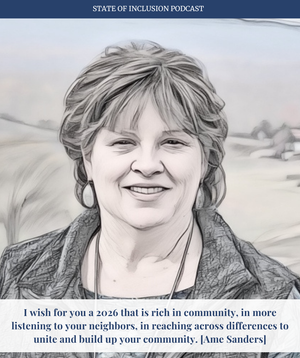
I wish for you a 2026 that is rich in community, in more listening to your neighbors, in reaching across differences to unite and build up your community rather than tear it down, to finding your place in this work of justice, equity, and inclusion, whatever that might look like for you.
I’m reminded of a phrase my French Colleagues at work used, Bon Courage.
It is a French phrase that they used to encourage one another when they were facing a difficult situation that required perseverance and determination. It was a sort of reminder that we make our own luck and that courage will help us through. But it also felt like an encouragement, a moment of solidarity, and a way of saying I’m with you.
So, let me wish us all Bon Courage in 2026.
CONTRIBUTORS
Host: Ame Sanders
Social Media and Marketing Coordinator: Kayla Nelson
Sound: Uros Nikolic