
Episode 91, 14 min listen
A lot of us are watching our economy fall short — for us, for our neighbors, for our communities. Our communities need us to step up. They need our time, our energy — and, yes, our money. After all, we are the economy. Our choices, individually and together, shape it. The good news is that change can start right here, with each of us. I’m going to take you along on a journey I’ve been on over the last couple of years that completely changed how I think about giving, investing, and spending. Fair warning: this is probably the most personal episode I’ve ever done.
AUDIO PLAYER
You can access this episode wherever you listen to podcasts via our pod.link.
ADDITIONAL REFERENCES
Maybe you just want to start by learning more about your current investments. There's a great tool that will help you evaluate your current investments, called As You Sow. It might surprise you to discover where your money is going.
If pooled giving with a group of women intrigues you (sorry, guys), check out Philanos, a network of pooled-giving organizations. Our local Greenville-affiliated group is Greenville Women Giving.
It is always good to get to know your local Community Foundation, like our Community Foundation of Greenville, they are a great resource to assist and advise you.
Learn more about venture philanthropy with Abundance Capital.
Learn more about accredited investing in local startups with Vicinity Ventures.
Can't get enough of local investing? Visit and subscribe to the Main Street Journal.
FULL TRANSCRIPT
-Introduction
This is the State of Inclusion Podcast, where we explore topics at the intersection of equity, inclusion, and community. In each episode, we meet people who are changing their communities for the better, and we discover actions that each of us can take to improve our own communities. I'm Ame Sanders. Welcome.
Hey, welcome back. If you caught our last episode, you heard us dig into Power Walks and Follow the Money. Today, we’re taking that idea somewhere a little more personal — we won’t be talking about the county’s money, we’ll be talking about our money. Well, my money, to be exact.
I’m going to take you along a journey I’ve been on over the last couple of years — a kind of Power Walk that completely changed how I think about giving, investing, and spending. A lot of people helped me figure things out along the way, and I’m hoping something in my story helps you, too.
Fair warning: this is probably the most personal episode I’ve ever done. Some of you might think, “Okay, that’s a little too much sharing.” Some of you will notice my privilege is showing — and you’re right, it is. And honestly, the more experienced investors and philanthropists out there might chuckle a little at how little I knew when I started. That’s okay. The only embarrassing thing about not knowing something is deciding you don’t need to learn.
Here’s what I do know: a lot of us are watching our economy fall short — for us, for our neighbors, for our communities. The past year or so has been a real wake-up call about how unreliable federal funding can be. Our communities need us. They need our time, our energy — and yes, they need our money.
And here’s the thing that keeps me going: we are the economy. Our choices, individually and together, shape it. The good news is that change can start right here, with each of us.
-So, here’s where my story starts.
About two years ago, I had a simple idea. Or, I thought it was simple. I wanted to put some of my retirement savings — my 401K — and some of my investments to work on the issues I care most about, right here in my own community.
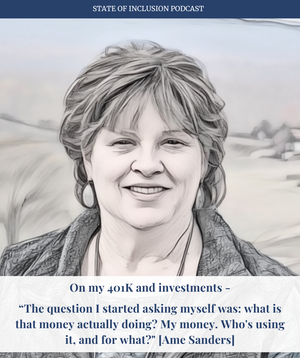
Now, I want to be honest: just having a 401K and investments is a privilege. I know that. But I’m not talking about being wealthy here — I’m just a regular retiree. And I think a lot of us are in a similar spot. In fact, we baby boomers are collectively sitting on a very large pile of money. The question I started asking myself was: what is that money actually doing? My money. Who’s using it, and for what?
If you want to check for yourself, I’ll drop a link in the show notes to a tool that lets you analyze your investments. You might be surprised what you find. I know I was. Maybe you’re unknowingly funding weapons manufacturers, private prisons, or companies with terrible environmental records. That’s worth knowing, right?
-Okay, before I go further, a few quick disclaimers:
- I am not a financial advisor or a CPA. Please don’t take anything I say as investment advice.
- I’m just a regular person with a 401K and a few investments. I’m grateful for what I have, but I’m not rich.
- I’m willing and able to take some risk, but I’ll need my money when I get old. Okay, sometimes I forget that I’m already old. So, let’s just say, when I get older.
- So suffice it to say, I’m a little risk-averse and need to preserve my capital.
- That said, I’m willing to accept a lower return if it means real impact in my community. I’m not looking to profit off someone else’s need.
-Step One: Learning the Language
The very first thing I ran into was that I didn’t even have the vocabulary to ask the right questions. There’s a whole world of terms out there I’d never heard of. So I hit the books, or the web, learned the lingo, and kept searching.
What I was looking for, I eventually learned, is called “local impact investing.” But every time I asked about it, people kept pointing me toward places to donate. I’ve learned that often the universe sends me just the kind of self work lesson that I need. So, even though my quest was for investments, I made a detour to take a hard look at my giving.
-A Detour Worth Taking: Getting Serious About Giving
And it was a detour worth taking. There’s a quote I love:
“When God blesses you financially, don’t raise your standard of living. Raise your standard of giving.”
That’s from Mark Batterson, and it stuck with me.
Before I retired, I gave generously through the United Way. Simple, low-effort — I sent money and let them figure out where in my community it should go. But after retirement, if I’m honest, my giving kind of... drifted. A donation here, a friend’s GoFundMe there, responding to whatever disaster was in the news. All of it was good-hearted, but none of it was very intentional.
So I sat down and wrote myself a giving intention statement. Mine goes something like this:
I want to strengthen community equity, inclusion, environmental justice, human rights, and economic mobility.
Once I had that written down, everything got clearer. I started noticing which organizations were already doing work aligned with what I cared about. I started going to their events, getting to know them, learning how I could support them — with money, sure, but also with my time and skills. Pretty soon, I had a whole new circle of friends working toward things we all believed in.
-Along the way, I found a few giving tools I hadn’t known about:
Donor-Advised Funds — Think of this like a giving account. You make a donation, get the tax deduction right away, and then decide over time where the money actually goes. You can set one up through your local Community Foundation, or through a brokerage firm like Vanguard or Schwab. It’s especially useful when you have a big income event — like selling a property or appreciated stock — and you want to claim the deduction now but need some time to decide where to give later.
Pooled Giving — This is exactly what it sounds like: pooling your money with others to make a bigger impact. It can be as big and organized as the United Way, or as small as a Sunday School class chipping in to help a family. I joined two groups locally — Greenville Women Giving and Together Women Rise — and it’s been wonderful. Bigger impact, new friendships, and a real education about what’s happening in my community and beyond.
Then I learned about Venture Philanthropy — I had literally never heard this term before last year. Here’s the idea: your donation gets used as a loan or investment in the community. So it’s a donation that gets invested. When it gets repaid, the money gets reinvested again. And again. It’s a gift that keeps on giving, literally. Right here in Greenville, we have Abundance Capital and the Micah Fund. With Abundance Capital, you can recommend where the investments go — that appealed to me, of course. With the Micah Fund, they manage it for you. Either way, it’s a really cool model.
-Now the Investing Part
Okay, I still wanted to make investments. So even after stepping up my giving game, I really wanted to find a way to put actual investment dollars to work in my community — while still protecting my financial future.
Angel Investing: I talked with a friend who is an angel investor and looked into this. To participate, you typically need to be an “accredited investor” — that means $1 million in assets, excluding your home, or $200K a year in income. Also, it usually means investing in individual startups or venture funds, which felt too risky for me. So I kept looking.
Crowdfunding for Investments: Just like there are crowdfunding sites for donations, there are platforms where non-accredited investors can put in smaller amounts. Vicinity Capital is one that hosts local investment opportunities. It was interesting, but the options were limited, still felt risky, and it wasn’t quite what I had in mind.
Community Development Financial Institutions (CDFIs): This was the most accessible option I found. CDFIs are organizations — like Self Help Credit Union here in Greenville — that exist specifically to serve their community. Your deposits are insured, just like a regular bank, and you can get your money when you need it. I opened an account there for some of my reserve cash. Safe and meaningful — but I still wanted something a little more directed.
Here’s what frustrated me: I couldn’t find a single, accessible way for a regular person like me to make a modest investment in community needs like affordable housing, closing the wealth gap, or even childcare capacity. Nobody wanted my money for that. That was disappointing and felt deeply wrong.
Some communities have figured this out, though. Mountain Biz Works in Western North Carolina, for example, lets anyone, that lives in North Carolina, invest as little as $1,000 for one to seven years at 3% interest. That money goes into a pooled loan fund supporting small businesses in 17 counties across western NC. These kinds of opportunities exist around the country — we just need more of them.
And we need that in Greenville!
Here’s what I’ve come to believe: when you’re clear on your intention, you’re far more likely to make it happen. And two years after starting this search, I’m happy to say I’ve made it happen.
I’ve recently signed a letter of intent to lend money to help fund an affordable housing development on community land trust property in a historically Black neighborhood right here in Greenville. I’m not a huge part of the project, but I’m part of making it real. A portion of my retirement savings now is going to help build homes in my community. That means something.
I won’t lie — it’s a little scary. I ended up committing more than I originally planned. I had to move money from my 401K into a self-directed IRA, which was a whole new thing for me. But I’m committed. And honestly? It feels right.
-Don’t Overlook the Power of Buying Local
A good friend reminded me that any conversation about putting money to work in your community has to include your spending. And she was absolutely right.
Not everyone can give. Not everyone can invest. But we all spend money. And how we spend it matters — a lot.
- Local dollars recirculate. Money spent at a local business can circulate 6 to 15 times through the local economy before it leaves. That’s a real multiplier effect.
- Local businesses give back. Local businesses donate 250% more to community causes — sports teams, charities, events — than big corporations.
Here are some simple ways to make your spending count:
- Eat at a local restaurant instead of a chain
- Buy food from local farmers, farm stands, or farmers markets — it’s fresher, more nutritious, and many accept SNAP EBT
- Shop local clothing boutiques, or go used
- Go hyper-local: barter, share, lend
One thing I’d add: not all “local” businesses are created equal. Take a little time to learn about who you’re buying from. Get to know them. Ask yourself:
- Do they pay a living wage and treat workers well?
- Are they welcoming to everyone, including folks with disabilities?
- Do they source locally when they can?
- Are they environmentally responsible?
- Do they give back through volunteering, grants, or sponsorships?
I’ve got my own list of local favorites — maybe you do too. Find them, support them, tell your friends about them.
-One Last Thing
Beyond our own personal choices, many of us have influence we don’t always think about. We make financial decisions for companies, churches, HOAs, nonprofits, and school groups. That’s another lever we can pull.
The bottom line is this: we can do more, influence more, and impact more than we often realize. It all comes back to intention.
So, what are you waiting for? Join me, let’s step up for our communities and do more to…
Give, Invest, and Spend Locally with purpose.
This has been the State of Inclusion podcast. If you enjoyed this episode, the best compliment for our work is your willingness to share the podcast or discuss these ideas with others. If you'd like to hear more about the practice of building an inclusive and equitable community, head over to theinclusivecommunity.com and sign up for our newsletter. Also, feel free to leave us a review or reach out. We'd love to hear from you. Thanks so much for listening, and join us again next time.
CONTRIBUTORS:
Host: Ame Sanders
Social Media and Marketing Coordinator: Kayla Nelson
Podcast Coordinator: Emma Winiski
Sound: Uros Nikolic