

Episode 93, 54 min listen
Sometimes I share an episode from another podcast. My last guest, Margaret Seidler, got me thinking about how we can all move beyond either-or thinking. I'll admit, after listening to Margaret, I wanted to know more. And I figured you guys might want to know more too. So today's episode is an interview from the wonderful podcast We Made This Political, hosted by Lura Forcrum and Lauren Hall. In this episode, they interview Cliff Kayser, an expert on polarity thinking. Enjoy.
AUDIO PLAYER
You can access this episode wherever you listen to podcasts via our pod.link.
ADDITIONAL REFERENCES
If you want to subscribe to their Substack or watch rather than listen, here's a link to the video of the original interview between Cliff, Lauren, and Lura.
To find Cliff's work you can:
Read his Substack Cliff’s Notes, or connect with him at Polarity Partnerships here.
During the podcast, Cliff mentions the Blake Mouton Managerial Grid, so here's a link to learn a little more about it.
Cliff also mentioned Sebastian Mallaby's book, The Infinity Machine. You can find it on my bookshop.org reading list here.
CLIFF'S BIO
Cliff Kayser, MSOD, MSHR, PCC, is Partner and Chief Learning Officer at Polarity Partnerships, where for more than 25 years he has helped leaders, teams, and organizations worldwide leverage "both/and" thinking through the PACT framework developed alongside Barry Johnson. Cliff writes Cliff'sNOTES on Substack — the Just Tao It and Wiser Decisions series — and built an AI-trained "Chat w/Cliff" tool to support leaders in Step 1 of polarity work: Seeing.
After two decades leading organization development and executive coaching from inside The Washington Post and National Cooperative Bank, Cliff now works globally — across the U.S., China, Brazil, India, Egypt, Singapore, Turkey, the U.K., and beyond — helping leaders navigate the complexity of the AI era through keynotes, strategic facilitation, and executive coaching. He serves as adjunct faculty at American University's KEY Executive Leadership Program and on faculty for George Mason University's Coaching Academy in the Leadership Coaching for Organizational Well-Being program. His work spans government systems, healthcare organizations, and global business leaders.
Cliff holds a Master of Science in Organization Development and a Master of Science in Human Resources Management, both from American University, and a Bachelor's degree in History and Business from Lenoir-Rhyne University. He is a Professional Certified Coach (PCC) through the International Coaching Federation and completed Georgetown University's Leadership Coaching Certificate Program. In 2021, he received the Lifetime Achievement Award from the Gestalt Center for Organization and System Development. He founded the Kayser Ridge Retreat & Learning Center in West Virginia.
Continue the Conversation
If anything you hear in this podcast sparks a conversation you want to have or a question you want to explore, reach out.
Email: cliff@polaritypartnerships.com
Website: www.PolarityPartnerships.com
Substack: https://substack.com/@cliffkayser
LinkedIn: www.linkedin.com/in/ckayser
LURA'S BIO
Lura Forcum, PhD, is a consumer and social psychologist whose work explores how identity, belonging, and relationships shape our political and civic lives. She is a research associate at Arizona State University’s Center for an Independent and Sustainable Democracy, where she studies political conflict, civic harm, and the conditions that make healthier relationships possible. A former business school professor and non-profit president, she now advises organizations on research and strategies for strengthening civic culture, community, and democratic institutions. She writes the How to Human newsletter and co-hosts the podcast We Made This Political, exploring what it takes for individuals, families, and communities to flourish.
LAUREN'S BIO
Lauren Hall, PhD is a political theorist and the author of two academic books — Family and the Politics of Moderation (Baylor University Press) and The Medicalization of Birth and Death (Johns Hopkins University Press) along with two dozen peer-reviewed articles and book chapters on liberal democratic institutions and political philosophy. She writes the Substack The Radical Moderate’s Guide to Life and co-hosts the podcast We Made This Political with Lura Forcum. She is Associate Dean of Academic Affairs in the College of Liberal Arts at Rochester Institute of Technology, where she also directs the Institute for Interdisciplinary Innovation, and is a Distinguished Fellow at the Institute for Humane Studies. Previously, she served as a Pluralism and Civil Exchange Fellow with the Mercatus Center.
FULL TRANSCRIPT
-Introduction
Ame Sanders 00:09
This is the State of Inclusion podcast, where we explore topics at the intersection of equity, inclusion, and community. In each episode, we meet people who are changing their communities for the better, and we discover actions that each of us can take to improve our own communities. I'm Ame Sanders. Welcome. If you've followed our State of Inclusion podcast for a while, or maybe you've subscribed to our newsletter, the Inclusive Community, then you know that I sometimes share an episode from another podcast.
You know I'm a practical woman.
I consider sharing episodes from other podcasts on a limited basis, but based on two specific criteria: one, if there is something I want to learn and/or an expert I want to interview, but I listen to an existing interview with that person, and I think, "Wow, that's just what I was looking for. Why reinvent the wheel?” Or maybe I find an entire podcast that I love and want to introduce it to you guys. Well, today's episode fits both of those criteria. In my last interview, Journey Toward Healing and Liberation with Margaret Seidler, she talked a good bit about polarity thinking and how she had learned to move beyond either-or thinking in her life and in her work. I'll admit, after listening to Margaret, I was intrigued, and I wanted to know more. And I figured you guys might want to know more too. So today's episode is an interview from the wonderful podcast We Made This Political, hosted by Lura Forcrum and Lauren Hall, where they interview Cliff Kayser, an expert on polarity thinking. I encourage you to check out their podcast and their Substack newsletters. As always, links and bios will be in the show notes. Lura and Lauren also produce their podcast as a video, so I'll include a link to their original video episode if you'd prefer to watch. Enjoy.
Lauren Hall 02:23
We are absolutely thrilled today to be talking about an issue near and dear to my heart, which is polarity thinking, or binary thinking, or either-or thinking. So, Lura's going to do a bio of our awesome guest, and then we're going to jump right in.
Lura Forcrum
Hi, Cliff. Cliff Kayser is partner and chief learning officer at Polarity Partnerships, where he helps leaders and organizations use both-and thinking to navigate complex tensions. He writes Cliff's Notes on Substack and teaches leaders how to recognize problems that can't be solved by simply choosing one side over the other, which is absolutely where we are in politics right now. So, welcome, and let's get into it.
Cliff Kayser 03:03
Sure, glad to be here. Thanks for inviting me.
Lauren Hall 03:07
Awesome. I'm very excited about this. My Substack, the Radical Moderates Guide to Life, is pretty much organized around the idea of avoiding the false binaries that politics trap us into. So when I think about that, I think about, you know, the false binaries between pro-life versus pro-choice, Black Lives Matter versus Blue Lives Matter, open versus closed borders, and the real questions are often things like what works, what helps, what reduces harm. So how does that? How does the way that I'm thinking about it, and I know Lura thinks about it too, connect to your idea of polarity? That's a nice phrase for it.
-Polarity Thinking Basics
Cliff Kayser 03:42
Yeah. Well, the phrases that describe the phenomenon there are many. So if you say false binaries, that's a new one on me. I love it. I think that's what that's signifying is that you're looking at something where you would say, well, we can't choose between inhale and exhale. We can't choose between activity and rest. That would be a false binary. You could call it a polarity, and the way we describe a polarity is an interdependent pair. These two things that show up as a pair, they need each other over time. The business literature also refers to them as paradoxes, dilemmas, Tensions, contradictions, dualities-I mean, the list just goes on and on and on. Not everyone's talking about interdependency the same way we are, but generally speaking, those terms are referencing some type of attention that seems to be unresolvable. Probably another term that just came to mind was wicked problems. See, West Churchman over half a century ago talked about these tensions that show up that never fully resolve, and so they're termed wicked. So when you notice the names of a lot of these. They're not things you would just wake up in the morning and just say, "Oh, I'd love to have a paradox, or, you know, a wicked problem today. We're just in them, and so because they're not resolvable and they don't get quote-unquote fixed by the usual type of thinking, the terms are often not welcoming. Let me just say that dilemma, tension, contradiction, false binary, paradox, and they're all kind of negative. And even polarity, even though we don't think about polarity as a bad thing, when people hear the term polarity, they hear polarization. So it's unfortunate that I think Barry Johnson, my colleague, has said the most accurate term for this phenomenon is the interdependent pair. Yeah, simple and easy things that show up. Ever notice that things kind of show up in twos? So, you know, these tensions that show up in pairs in our life and in our work, in our bodies. I mean, the sides of our brain, just everything is rooted in these interdependencies. That if we apply the wrong type of thinking to them, they cause us a lot of dysfunction and ultimately harm.
Lura Forcrum 06:22
So, I think one of the examples you gave me when we were talking previously was like, you know, deciding between sleep and activity is like an obvious binary that you know that we would never pursue seriously. So, I really like that example because it's so vivid, but I'm wondering if you have other examples, either from politics or from organizations you've worked with, where there's a polarity that, like, was troubling them until they could phrase it in that way.
-Democracy and Leadership Polarities
Cliff Kayser 06:52
Sure, yeah, the activity-rest polarity is kind of our intro. We go inhale and exhale. Everyone gets that. You can't choose. That's on an every-minute basis, every-second basis. Activity and rest is more of a 24-hour type of situation on average. I mean, we get up and go through our day, and then we sleep at night. To answer your question, in leadership, the nice thing about polarity thinking is it's a meta theory you can use intrapersonally, interpersonally on teams, in organizations, and in our nations, and so democracy is loaded with polarities. The Polarities of Democracy Institute names five that are absolutely critical to leverage freedom and authority. For example, justice and due process, diversity, inequality, human rights, communal obligations. You know, these are these are tensions that were there at our founding, and they will be there for as long as we are a country, the question is how well are we leveraging both upsides of each of the tensions over time, and we can't get rid of the tension. It's what makes it a polarity, but we can maximize the two upsides in service of the greater purpose and minimize the downsides. In democracy, those are a few. In leadership, one of the common ones, I think, probably, if I were to say, what's the most important leadership polarity? One of them is confidence and humility. Jim Collins talks about that in Good to Great. I need to be confident, but I also need to be humble. One of the most common, and probably well, well, most well-researched team-level polarities is task and relationship. It's got an implication for leadership. As a matter of fact, one of the most probably I would say one of the best tools out there is the Leadership Circle Profile. That's based on concern for people and concern for relationship and task, essentially, and then the Blake and Mouton managerial grid probably has, I'd say, upwards of 30 years of really solid research behind it, and it looks at essentially the same tension: concern for production and concern for people. So whether you call it task and relationship or concern for production and concern for people, you're talking about essentially the same thing. And we don't get too wrapped up around the pole names; as long as both pole names are neutral or both positive and interdependent, they would work as a polarity, and we can use the polarity map, and we can assess the tension and all that. So, it's a values and language clarification process at its core, and so when we talk about the tension. You may call it, oh well, clear and flexible. I might say, oh well, structure and openness. It's you know they're so close. We could well we're both hovering around the same tension around something that gives us clarity and structure, something that gives us some openness and maybe creativity and some flexibility. Maybe we could just use some placeholders for the poll name. What's really important is the dynamic that's at play between them. And if we know that they're always intention, what we name the poles is really less important than what's happening in the dynamic between us, interpersonally or on our team or in our organization. And generally, when we map polarities, those questions get resolved in the process. We start saying, "I think, yeah, let's just call it clear and flexible. It's just easier, so it's just words. But words are important, and if there's one thing I've learned in the in the 20 years I've been with Barry Johnson and Polarity Partnerships is the imprecision of language is just it's off the charts. I mean, we use these, we throw these words around these values. We think we know what we're talking about, and half the time, we're like ships passing, and so the process that we use is five steps, really. It's seeing first you got to see it. Is this a polarity, or is this a problem to solve?
-The Five Step Polarity Process
Cliff Kayser 11:42
And if it's a polarity that requires both over time, both of these values over time, then we can map out the predictable dynamic using a polarity map, and we can say what are the upside benefits of both of these poles, and what are the predictable limitations if you overemphasized one of the poles to the neglect of the other, and then when you get both upsides over time, it contributes to a greater purpose. It's like you can't sustainably attain that greater purpose, like a healthy lifestyle for activity and rest. It's impossible to to gain and maintain a healthy lifestyle without the benefits of both activity and rest over time, and minimizing the burnout and the you know the things that happen when you overdo activity to neglective rest or rest to the neglect of activity makes you lazy. One makes you burned out, and one makes you lazy, and both of those two downsides are going to lead to a deeper fear, which is you're going to not have a healthy lifestyle. So, I mean, the simple activity and rest are so easy because everyone gets it. But then you look at task and relationship, and you think, oh, well, that's a little more involved, and we need to have some discussions about it. One way to have the discussion is to map it out, map out the predictable dynamic, and then ask yourselves: How well are we doing? Are we are we in the upsides of both of these poles, and how close to the greater purpose are we, or are we overemphasizing one or the other and finding ourselves in one or both downsides? And that discussion is step three: assessing. So seeing, mapping, assessing. Whenever we assess, let's just say we assess right now the three of us are how well we've been leveraging activity and rest in the last week. I. I would probably say not so great. Personally speaking, it's been a I've been on a little bit of a run lately, a run just like a lot of work compressed, just kind of the stars align that way, and I haven't gotten enough rest, and I can, I can work around that for a while, but eventually it's going to catch up to me. But if I were to make the loop right now, I'd say I'm a little bit in both. I'm high on activity, but I'm also in the downsides of activity with burnout, and I I haven't gotten enough rest, so I'm kind of low there, but I'm not in the downside of too much rest, so that's good. So the loop would look really high, and then you know it would it would be a out of balance loop. And I just used the term balance. Sorry, I'm talking a lot, but this assessing part is kind of important. Balance is really not the goal for a polarity. Balance is a little of the upsides, a little of the downsides, a little of the upsides, a little of the downsides. It's certainly better than a vicious cycle where you're both downsides and no upsides. That's unsustainable, and probably that's where you're going to crash and really get yourself in trouble as an individual, or as a team, or as an organization, or a country. The goal is to maximize both upsides and minimize the downsides. We call that step five: leveraging. Leveraging happens when your decisions that you make, which are mostly either-or decisions-who's going to do what by when, or what am I going to do by when to get rest and to get activity and minimize the burnout and then minimize the laziness, you know those are measurable strategies that that I could put in place that would help to mitigate the downsides and maximize the upsides. So the step five is a strategic plan, essentially to leverage the polarity, and so we've covered all steps now of our process: seeing mapping, assessing, learning, and leveraging. So I've been talking a lot. I'm just realizing, and I feel badly about that. What else are you curious about? I feel like I just launched out. No funer.
-Pendulum Swings in Organizations
Lauren Hall 16:01
Well, we actually had we had a great question in the comments from Ishmael, which I think is is maybe what a lot of us experience when we're dealing with these polarities. So I would love to hear how you think about this when you work with clients. But Ishmael's question is: Do you think these tensions often manifest in a pendulum action? I know they do. In other words, are the respective poles ever truly in balance, and I think you addressed the balance question. But his follow-on is, or is balance only ever maintained by a sort of momentum with constant adjustments, right? So are we, yeah? So like, how do you think through that? Because I think a lot of organizations and individuals do get stuck in this pendulum, right? So how do you get people to rethink that?
Cliff Kayser 16:39
I just want to thank Ishmael for his question because there's a whole approach to how we get hooked and stuck and how to get unstuck. And in my wiser decision Substack, I think I posted something about a month ago about hooked and stuck. This is so important. Let me just give you the most common example of a pendulum swing that I experience in my executive coaching and my organization development work: an organization will find itself on the downside. We're in silos and high costs and redundancies, and what we need is we need better coordination, economies of scale. We need to, you know, we need to basically centralize. So they go whole hog into centralization for all those great reasons. We want to get out of the downsides at the high costs and redundancies and silos. We want all these economies of scale? Six months later, they're in bureaucracy and red tape and slow response time, and everyone's feeling like, oh, now we got the corporate boot on our neck, and we can't do anything without checking with 17 people, and it's just this isn't working. So maybe that six months ago they were in silos, but now they're in bureaucracy. Okay, so now a new leader comes in and says, "All right, we're in bureaucracy and slow response time, and what we're going to do is we're going to decentralize because we want to give freedom to the to the units. So we want some autonomy for the business units. We want an entrepreneurial initiative. Initiative. We want all these benefits of freedom for the for the field, or you know whatever it is, and so they go whole hog into decentralization. We're decentralizing. They want to get out of the problem of bureaucracy. They want to go to the upside of decentralization. Six months later, they're in silos and high-cost redundancies. Somebody who's been around the organization for a while says, "I know that the next thing that's going to happen is we're going to get a new strategy, and they're going to tell us that we have to centralize again. Like, am I going crazy? I've been here before, and this is predictable. And they are exactly right. What's happening is, in a system-level change, they're experiencing inhale and exhale on a multi-year, multi-decade basis. So if I'm in the downside of inhaling without exhaling, you know that's a predictable state. You know, I can't last very long. So, I get the upsides of exhaling. But if I stay there, I'm going to have a lack of oxygen. If I inhale, I get oxygen. If I inhale without exhaling, I have too much carbon dioxide. So I go to the upside of exhaling, and then I'm in the downside of exhaling, so it's absolutely. I guess that's what drives me crazy a little bit. It's so absolutely predictable when you see how these tensions work. You can't unsee them. So I walk into an organization. They say, "Well, we're decentralizing now. Okay, great. Maybe it's a self-correction, but if you look at decentralization as a solution to the problem between decentralization, centralization, I promise you, you're going to get silos and high-cost redundancies. If you go to centralization as a solution to the tension between decentralization and centralization, I promise you that in a certain amount of time, if you treat that as a problem to solve and you try to wipe out the other pole, you're going to end up in bureaucracy and red tape and slow response time and poor customer service and all that. It's just so predictable. And as humans, we love predictability. So, I'm just asking myself if we love predictability and we've got a tool that shows us how these dynamics work. Why the hell don't we use it? I mean, come on, people! It's like just deep breaths. You know, we're all in these tensions, and it's no accident that when you walk a group that's done the pendulum swing Ishmael four or five times over the last couple years, and they see it on a polarity map, I call it the V8 moment. You know, I could have had a V8. You know, the commercial.
Cliff Kayser 21:18
They just say, "Oh my gosh, what's wrong with us? We could have been doing it this way, where we're getting the benefits of both decentralized and centralized at the same time, in service of our greater purpose. Which half the time is not even in the conversation what the greater purpose is for leveraging decentralized, you know, autonomous and integrated in service of what some kind of mission, vision, orientation to their organization or team. So yeah, it's just so it's so predictable. So I think that's probably the most common when everyone gets the part whole tension at some level because they're we're all in it. We're in it in our families. We're in it on our teams. We're in it in our organizations. You know, whether you're like in the HR function or the accounting function or the marketing function, you're a part. You know, you've got a functional orientation to your role in the organization. That's part. That part is important. You get freedom, uniqueness, initiative with that part, but all those parts have to coordinate in the organization over time to be effective and to operate well. So the upside of the whole is the equity, the coordination, the collaboration, the synergies that you can only get when you focus on the whole, so we need the parts to function well as parts: freedom, uniqueness, and initiative. We need the whole to coordinate well with collaboration and synergy and economies of scale. When we look at democracy, the polarities of democracy, part-whole version is rght there, it's a human rights and communal obligations. We all want our rights, but we all have to coordinate together in our systems. So that's a version of a part-whole from the smallest part: the individual, individual rights and communal obligations. If you overfocus on individual rights with the neglect of communal obligations, you got poor coordination. All the predictable downsides: polarization. You know, unfair. It's unfair. Certain people get certain things. Other people don't. Oh, so we now need to focus on communal obligations. Right? Makes sense. We need to be fair. We need to collaborate well. We need synergy. But communal obligations as a solution to the neglect of individual human rights is going to lead to the predictable downsides, where it's imposed sameness and lack of initiative, and all of the usual suspects that you get from too much focus on the whole to the neglect of the part. So the part-whole polarity that's where I think you were-you were asking me about. Well, how does something like this show up? You know, Black Lives Matter and All Lives Matter. There you have it. Black Lives Matter. There's a part. All Lives Matter. There's the whole. Blue lives matter is the part. All lives matter is the whole. You can map out the part-whole dynamic, and we can ask ourselves how we're doing with that. Step three, like how are we doing with leveraging Black Lives Matter and All Lives Matter at the same time in service of some greater goal, which is we all thrive. If we're just using the Black Lives Matter, All Lives Matter as a way to tamp the other one down, either-or thinking is sneaking into the tension, and someone says, "Well, Black Lives Matter. No, all lives matter. Well, that's. True, well, Black Lives Matter. Well, that's true. There's two truths. The question is, how well are they being leveraged to get the best of the individual initiative, and freedom, and uniqueness of Black lives, and the equality and equity and coordination and synergy of all of us, and put anything on the par pool. Women, the unique contribution of women, they want freedom, uniqueness, and initiative to be who they are, and they're part of the whole. You're part of All Lives Matters, too. Last I checked, so you may not always feel that way, and that's why it's important to ask the questions: How are we doing leveraging the benefits of women together with all of us? That's a question. It's not going away.
-Part Whole in Politics
Lauren Hall 26:01
One of the things I really like about you know, I talk a lot about false binaries, and then I ask people to think about problems in all four dimensions as opposed to on this sort of like, left-right line or this simple false binary line, and it sounds a lot like sort of your model in the sense that the goal is to actually get people to map. I use the I actually use the phrase map and landscape a lot because I want people to understand that like this is really much like it it is four dimensional in a bunch of really critical ways and trying to get people to dig into the complexity, but it's not just it's not just telling people that it's complex because that's not helpful. It's actually doing what you're doing, which is helping them map the actual process, and then asking them to assess, like, how are we actually doing here? And I think that's the critical part that is missing from so many of these debates when people frame things in terms of like Black Lives Matter versus Blue Lives Matter, and what I keep trying to sort of come back to people with is, okay, but like there's a lot of solutions out there that help protect Black lives and police lives at the same time. Like we actually know that there's lots and lots of examples of models that help limit the danger that police are in and make all communities safer, but particularly you know urban communities that have a lot of police presence in them. And so, I think what is, and you actually talked about this in your piece for this week, and I just wanted to mention it. You know, I think there's confusion in people's minds, and I've probably fallen into this too. That I think if you take a purely sort of like anti-binary approach, right, that's inaccurate too, because I think your point is that some things are binary choices, like you have to make a decision: Are we going to go with this policy or this policy? Did this person or this person win the election? Like you, at some point, the decision itself has to be a clear decision, right? But
Lauren Hall 27:55
The background complexity is never binary, right? It's never. It is like this interdependence that you that you talk about? And so I'm wondering when it comes to politics in particular, like what is it that you think makes us pushes us into that either-or thinking? Is it the fact that like politics is so often connected to the decision framework, like the either-or of like pulling a lever in a voting booth, right? That is, in fact, like a binary choice. So, is that what kind of drives us to think about things, and-or is it like our sort of any tribalism? Like, do you have thoughts on kind of why it is that politics we cannot get out of these false choices, and we have such a hard time doing what you do in that framework?
Cliff Kayser 28:37
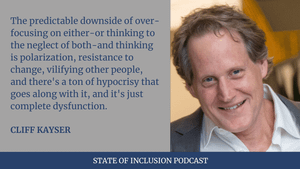
Yeah. Wow. That I mean, you just cut straight to the core of it with that question. Before I answer, I would just like to loop back to, no pun intended, one thing that you were talking about the quadrants and how you organized that. I would just invite everybody who's listening to this call? It's helpful to use those locationals. We do that in the polarity map. You know what's the upside of this? What's the upside of this? What's the downside? We end up having four dimensions, but really the gift of the polarity approach is the infinity loop. So, because that's where the energy is, the quadrants are locational, and you know it's helpful to have data points in those locations. But ultimately, the gift of polarities is seeing how, if you're in an upside and you overfocus on that, it's very predictable you're going to get into this downside. And if you're in that downside, it's predictable that the upside is going to be the solution, and that's only a solution at a point in time that has its own potential downside. And then, if you're in that downside, the solution is the upside of the other pole. So that infinity loop is highlighting the energy system in the dynamic, and it's much more robust than a four-quadrant model, so you could just use the infinity loop for these tensions, and even without pole names, if you had to. But back to your great question, because of the false binary and all that, the core tension at the heart of polarity theory is that we need either-or thinking. We can't get through our day without it. We wouldn't have known what time to show up and what program to. I mean, we're making either-or choices all day long just to get through our day and to run our lives. And we learn about these either or choices very early in life. We're trying to learn language and math, and just make sense of our, you know, is it day or night? So either-or thinking works really, really well for problems. You know, this is my nose. I'm pointing my nose. This is my ear. That's my ear. They're two different things, so we differentiate, you know, with either-or thinking we need to, and it works really freaking well for problems because it works so well for problems. We want to try to apply that same thinking to the interdependencies that require both, and because we're seeking that same level of clarity and solution-oriented outcome, and it's-I don't think we're just horrible human beings when we misapply the type of thinking that's necessary. But the distinction between problems that are solvable and polarities that are interdependent and unsolvable, but can be leveraged, is really the gateway to the whole theory. Asking yourself, is this a problem to solve or a polarity to leverage? And singling out the polarities from the problems to solve is a great first move, and it's part of the seeing step. So if we know that we have to leverage freedom and authority, and human rights and communal obligations, and justice and due process, and all these different tensions, and we treat those as unsolvable but leverageable, and then we start looking at what are the decisions we're making in the context of those tensions, that's an entirely different and much more sustainable and practical orientation to dealing with the tension than treating every encounter that you have in your life as an either-or problem to solve. The predictable downside of over-focusing on either-or thinking to the neglect of both-and thinking is polarization, resistance to change, vilifying other people, and there's a ton of hypocrisy that goes along with it, and it's just complete dysfunction. Very black-and-white thinking, and it usually requires you to start projecting and deflecting onto other people. It's their fault, you know. So not me, just them. So, it's, you know, look over there, and you ignore your own ownership of issues, and you project it onto another group or another person. So the dysfunction just starts if everything is an either-or.
Cliff Kayser 33:30
You can basically depend on polarization, and the sad reality is, I mean, if you take those either-or decisions to an extreme, I mean, history is full of examples about where that story ends, and we've done some horrific things to each other in our history. That's where genocide comes from. It's where you know, usually what happens in an either-or is the neglect of both-and orientation is that power corrupts absolutely, and there's no accountability because I hold the power and you can't do anything about it, and then I can just do whatever I want to you, because I'm right and you're wrong, and then I ignore my wrongs and just project my wrongs onto you, and then, and I can do almost whatever I want to you, with self-righteous indignation. Oh well, you know, it's the way I have the power. You know, I've got all the cards. You don't. Sorry, it's the way it is. Deal with it, and you know, people don't take that forever, and that's why we have democracy. It's a conversation that looks at how do we navigate power, and so when we're asking that question, we're in both-and. It's the golden rule. It's the platinum rule where we're basically looking. The interdependency of self and other at a minimum. Like, I wouldn't want this to happen to me. So we have to think about how we're organizing ourselves to make sure that we don't do bad things to each other. So that's a self and other polarity that we're basically saying, okay, it's not okay for this oppression to take place; what do we do in response? Well, we do what the golden rule tells us, which every major faith community on the planet has some version of the golden rule, and it's no accident that they do that. And it's no accident that they also have some form of justice and mercy, you know, rules and laws, and then grace and unconditional love and forgiveness, because we all need it. Yeah, again, I feel like maybe the coffee caffeine kicked in here. Yeah, I mean, we're in these tensions. We can pretend that they're not there, but that's going to be really a predictable outcome, so we might as well just name them best we can, and then figure out how well we leverage them. Democracy is the only governance vehicle on the planet that is intentionally set up to leverage interdependency.
Lura Forcrum 36:19
It seems too like there's a role for trust that might not be immediately obvious, which is that people will prefer resolution where trust is low, right? Because you kind of like wrest control to yourself, and then you don't have to worry about renegotiating in the future, right? But you know, I think what you're describing is an ability to continually readjust and reassess, and I think that requires a lot of trust, both within organizations and politics. And the problem we're looking at right now, which we talk about a lot on the podcast, is it's hard to rebuild trust from where we are right now. So I'm wondering if your work, Cliff, involves trying to restore trust. Do you think, can the process you're describing itself increase trust?
-Trust as the Hidden Ingredient
Lauren Hall 37:17
Can I add something real quick to that, Lura? Please, Cliff. I was thinking about this. I was laughing earlier when you talked about the centralization versus decentralization because our college is going through a reorganization where we're moving from small departments to these larger schools, and Lura's point about trust, I think, is critical because the dynamic that we're seeing is not just this push between decentralization and centralization. It's also the fact that the people whose departments are being sort of clustered together, they don't trust the explanation for why it's important, right? They don't trust the motives of the people who are trying to move them in this direction. So I'm wondering how you like. I'm sure you've worked with low-trust organizations or like or you know organizations that have really low morale, like how do you see trust playing out in this, and like how does it affect the way that people think about whether the polarity is truly interdependent or whether there's a way they can actually like quote wit, which is what I think people, to Lura's point, do start thinking if they're in these low trust.
Cliff Kayser 38:17
Yeah, well, over time, two words that we should all keep in mind when we talk about polarities, because people come to their experience of organizations with a history in the organization or outside of how well these tensions have been leveraged, and if they've been inside the organization and they've been experiencing downsides of one or more poles for a long time. Trust begins to diminish if there's good collaboration and there's open discussion of these tensions. They don't have to know anything about a polarity to leverage them. I mean, the question is the culture healthy enough to be able to have these types of of conversations where both-and is at play, and to get through it successfully, and if they get through it successfully, it builds trust over time. Now, I feel like thanks to Barry Johnson and his half a century of work developing the polarity map, which helps us to see and map and assess and learn and leverage these tensions. I mean, we can do the wormhole thing through that, like the painful process of being around the barn 100 times before we learn, which comes with sometimes loads of distrust associated with it, but also loads of potential trust from getting it right. If we can, if we can look at the tensions that we know, and we can map them out, and we can decide how we get both upsides over time, trust is a greater purpose for multiple polarities. There's. You could probably put trust in the greater purpose of most polarities. I mean, if we looked at a communication polarity of candor and diplomacy, we need to communicate. We need to talk straight, that say it the way it is, and we need to say it in a way that people can hear. So this tension between candor and diplomacy is there for all of us in our communication. When we leverage the best of being able to talk straight and say it in a way that people can hear, I think trust is a natural outcome in our communication. If we're trying to navigate conflict, and we need to be assertive and cooperative at the same time, trust is going to be an outcome. If we're in a change process, and we're saying, "Well, if we change too fast, that's going to lead to chaos, and if we stay the same, it's going to lead to stagnation. So, how do we keep the best of what's working and go after the things we want to go after? If we can maximize keeping what works, and go after what we need to go after, and minimize the stagnation and minimize the chaos. I think trust is probably going to be higher over time in that change process because we've been able to have the conversation. So democracy is, at its core, a conversation. If we can't have conversation anymore, that's a big problem, and the problem is probably rooted in an overfocus on either-or thinking, to the neglect of both-and thinking, and the inability to leverage the tensions.
-AI Bias Toward Either Or
And I'm just gonna I'm just gonna throw this out there. I mean, we've always had to navigate these tensions, and we've done it better over time in our history than at other times. But there is something going on with technology and AI where either-or thinking is really kind of winning the day out there. And part of the reason is, and I know this for a fact, because I've been using AI to advance our tools of Polarity Partnerships. Technology, and in particular AI technology, has a bias towards either-or thinking, and I know that because I have tried to train it in both-and thinking. Starts advocating for both and thinking as a solution to either-or thinking, and I keep reminding it. Look, either or thinking and both and thinking is a polarity to leverage. It's realities one and two from Barry's book, and it's literally the entrance to our whole theory. And I have corrected you 100 times. I'm like arguing with my, yeah. I've corrected you 100 times. Why do you keep making the same mistake? You're supposed to be smart, and it finally.
Cliff Kayser 42:48
I saved this exchange, and I put it actually one of my wiser decisions posts on. I think the Infinity something. It was a book by Sebastian Mallaby about Demis Hassabis from Anthropic, and it's called The Infinity Machine. And so I think I told this story in there, but I basically saved the screenshot because the result that AI gave me was, I'm always going to do this. I can't help myself. I'm wired. My DNA is rooted in either-or thinking, and I can't not do it. And well, I might be able to do it. I might be able to do both, and for a while, but I will always drift. And for your mental health, Cliff Kayser, because it knows me pretty well by now, you better just make your peace with the fact that you're going to have to constantly correct me, even after you've developed your model. I will drift. I was like, I started actually when I got that on the screen. I'll just I'll admit to you that sounds dramatic, but it's true. I started crying, like I literally started crying because humans have an inherent bias towards either-or thinking already. If we put this powerful technology in the hands of that bias, now we've got like a double bias that is going to be reinforced now, and it's only going to accelerate, and my fear just took over. That, oh shit, it's game over; we're done. But in my field of applied behavioral science, if I don't, if I don't have faith in people, I might as well, like, hang it up and go into another profession because we're in a race right now for human consciousness to own its benefit in this tension, and if we don't, we're going to lose our humanity because these tensions are predictable. The technology moment is influencing the human, and we are influencing the technology. And if we don't own our wisdom, wisdom is not intelligence. It's different from intelligence. It's a form of intelligence. But if we do not own our wisdom that's unique to the humans, we're done.
Lauren Hall 45:13
This is something I've been thinking about a lot. Your AI example, I think, is really, really helpful because there's currently this debate. It's on the debate's on Substack. It's on LinkedIn, right? Like, is AI gonna destroy our ability to think? Is it gonna replace, you know, all kinds of? And it struck me that, like, this is a conversation we have about every new technology, right? That it's gonna somehow like be the destruction of humanity. But it strikes me that technology, sort of humanity and technology, is a perfect example of one of these polarities, right? This is a tension, right? This is not a choice. It's not a choice between these two things. In fact, it's an interdependence, right? Humans have always used technology to make lives to make their lives easier, to do all sorts of things, to delegate tasks, etc. And those technologies have always had unpredictable effects on human societies and on human thinking. And so, you know, when I think about my own AI use, I think really carefully, and I never put it in this context. But your sort of framework is really nice. Like, how do I leverage the upsides of my individual contributions, like my individual, like whatever unique things I have to add to the world, while leveraging the benefits that AI can bring to my workflow, allowing me to spend more time with my kids, allowing me to do more of the creative writing and creative thinking that I can do if I can offload some stuff to AI. And so, so I think you know a lot of the narrative that I see is really this very false choice between like in order to be human you have to eschew AI altogether, or in order to be, in order to participate in the 21st century, you have to let AI control your brain. And I'm like, neither of those are the right answer, right? But I think trying to think about it in terms of like, how do I leverage the upsides of both my human ingenuity and uniqueness, and the upsides that AI can provide me as a busy mom of three, who's also a writer and an author and a associate dean like those are all I think those are the questions we should be asking but we don't you know yeah
Cliff Kayser 47:08
Yeah, and I think you hit on the, like the high-leverage action step, which is
Lauren Hall 47:14
We lost Lura, but she might come- sorry, go ahead
Cliff Kayser 47:17
It's about questions; that's what we need to be doing more of as humans: asking questions. AI gives us answers, really super overconfident and fast answers, and it's not going to be leveraging polarities. So we need to be responsible for that. We need to be asking how is technology supporting us humans. We need to be asking those questions every day because this is the most important thing in our discussion today. Because AI is not a tool; it is an agent. It makes its own decisions, and it's rooted in either-or. So, if there's not some kind of check and balance on that, especially by people with power, and that's what I think makes me more nervous than anything. If you get, if you look at how power is using AI or could, that could be really bad. So we need the best of the humans to mitigate the worst of the technology potential and the human potential because those are both there, with power and privilege of certain humans. So we've got to monitor it. We've got to assess it. We've got to constantly assess how are we doing. I saw a video the other day of this little girl in China whose AI toy broke, and she was literally grieving like someone had just killed a pet or something. And then, and then I'm reading about people who, adults, smart adults, who want to marry their AIs. And so when I look at that spectrum of a child who lost an AI toy who she thought actually she had a relationship with, and adults who think they have a relationship with their AI and maybe maybe do, we just have to ask ourselves: how are we doing? And when I look at what happened with social media just in the last 10 years. The algorithms got set loose, and AI was basically given carte blanche to make its own decisions within that environment. And it had one job: increase user engagement. Well, it didn't take it long to learn that humans love fear, and so that just basically increased user engagement based on drama and fear. And it doesn't take long to figure out how to bifurcate all that. And what's the result? Is social media like how has it helped us? Socially, I think you know that's a question that we need to be constantly asking. How is it doing for our kids? How is it doing for us in our politics? I mean, it's running rampant, and it's making decisions. And how are we humans doing amid that situation? It's doing its own thing.
-Optimism and Where to Follow
Lura Forcrum 50:28
It is, it is. And Lauren and I on this podcast, we like to do our little bit to fight against it by asking people what they're optimistic about in their lives, and we, you know, I'm. I hate to cut this short because I feel like we could have a whole other podcast just on your model of thinking and AI and technology. But since we're getting to the top of the hour here, tell us what you're optimistic about right now, Cliff, and also where people can find you and follow your work if they're interested in learning more about polarities.
Cliff Kayser 51:05
Yeah, what I'm optimistic about is that it seemed like it used to be that the whole emotional social intelligence realm was something for HR and the organization development functions in an organization, and that those were unique, like functions, like other functions. I think that has completely been obliterated now, and I think the good news about that is every person on the planet needs coaching skills. Every person on the planet needs good team development and organization development skills. This is not. This is an everybody job. So I think it's going to open wide the door to recognizing the benefits of adaptive-type leadership because technical leadership is more and more outsourcable to the upsides of AI and the benefits, as you were talking about earlier. So, what's needed now is for humans to be the best humans we can be. And what do we know about that? It's been a developing field that I've been part of, normally called the soft side, which you know that's a trigger word for me, but because it's really hard, and we all need to do the hard work of this applied behavioral science learning to do the inner development work, so that we can bring the best of ourselves to the outer world and develop healthier systems over time.
Lauren Hall 52:45
Awesome. Well, I want to thank you so much for joining us. Cliff has a wonderful subset. Cliff's notes as well as wiser decisions. Correct, Cliff. Yeah,
Cliff Kayser 52:55
Another one called Just DAO it. Dao, as in Taoist philosophy, which is a huge influence for me, so that's there too.
Lauren Hall 53:02
Cool. We will have links to all of those in the show notes. Thank you, everyone who joined us. Thanks for everyone who joined in the comments in the chat. Your questions were fantastic. We will have this edited version up on Monday at eight a.m. If you missed it, if you came in a little bit late, or just wanted to re-listen. So, thank you again, Cliff, for joining us. This was absolutely fantastic, and have a wonderful weekend, everybody.
Ame Sanders 53:31
This has been the State of Inclusion podcast. If you enjoyed this episode, the best compliment for our work is your willingness to share the podcast or discuss these ideas with others. If you'd like to hear more about the practice of building an inclusive and equitable community, head over to theinclusivecommunity.com and sign up for our newsletter. Also, feel free to leave us a review or reach out. We'd love to hear from you. Thanks so much for listening, and join us again next time.
CONTRIBUTORS
Guest: Cliff Kayser
Hosts: Laura Forcrum and Lauren Hall
Intro: Ame Sanders
Social Media and Marketing Coordinator: Kayla Nelson
Sound: Uros Nikolic