

Episode 92, 50 min listen
By sharing her personal story and painful family history, today's guest, Margaret Seidler, takes us along on a journey with her, a journey of discovery, of reckoning, and ultimately, of liberation. Along the way, we are reminded of the ability for story and art to connect us, to open our hearts and minds, and to help us find a different way into difficult discussions.
AUDIO PLAYER
You can access this episode wherever you listen to podcasts via our pod.link.
ADDITIONAL REFERENCES
Learn more about Margaret's journey and about her book at www.payne-fulbusiness.com.
See more of John W. Jones artwork and purchase at Gallery Chuma.
A short overview of polarity thinking from Harvard Business Impact.
MARGARET'S BIO
Native Charlestonian Margaret Seidler is a retired leadership development and conflict resolution consultant. In her acclaimed book, “Payne-ful” Business: Charleston’s Journey to Truth, she traces her journey after a late-in-life DNA test reveals distant cousins of African descent. Motivated by their ancestral search, she uncovers three generations of slave traders in her family, including William Payne, a giant in the domestic trade. The journey continues this year as Margaret unearths the story of a young runaway, Molly, sold by Payne.
FULL TRANSCRIPT
-Introduction
[00:00:00] Ame Sanders: This is the State of Inclusion podcast, where we explore topics at the intersection of equity, inclusion, and community. In each episode, we meet people who are changing their communities for the better, and we discover actions that each of us can take to improve our own communities. I'm Ame Sanders.
Welcome.
If you've followed our State of Inclusion podcast for a while, then you probably know that we've had several past episodes where we talked about the importance of story and of art to connect, to open our hearts and minds, and to find a different way into difficult discussions. This episode brings that theme front and center.
By sharing her personal story and painful family history, today's guest, Margaret Seidler, takes us along on a journey with her, a journey of discovery, of reckoning, and ultimately, of liberation. Before we start, a small aside. Our guests freely share their stories with us, so we make the podcast, our newsletter, and related content free as well.
If you would like to support us in growing our work and help to offset production costs, you can find a link to our Support Us page in the show notes. We're happy that you found us. We're grateful that you listen, and we would be thankful for your support.
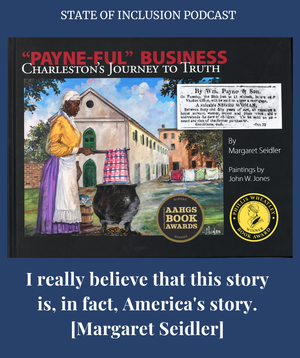
So today we're happy to welcome Margaret Seidler. Margaret is the author of the award-winning book, Payne-ful Business: Charleston's Journey to the Truth with artwork by John W. Jones. Margaret, thanks so much for joining me today. It's a real honor to be here with you, Ame. So the title of your book is a bit of a play on words, with the word that we normally think of as pain, P-A-I-N, it's spelled P-A-Y-N-E, and the subtitle is Charleston's Journey to the Truth.
Now, I've read your book and heard you speak. It's a lot more personal than just Charleston's Journey to the Truth, isn't it? It's about your own journey. So maybe if you would start by telling us a little bit about your journey, what you learned about your family's past, and how you came to write this wonderful book.
-Margaret's DNA Discovery
[00:02:35] Margaret Seidler: It's been, uh, an interesting journey, and I will say that the reason the name of the book is Painful Business, P-A-Y-N-E, hyphen, F-U-L, is that a family name that I have now researched was Payne. So it's actually named for them. And what's interesting about Charleston's Journey to Truth, when I wrote the book, I initially entitled it My Journey to Truth, and what I realized before I released it was that this journey is much bigger than me, that it is in fact Charleston's journey.
And if I had to do it over again now, which is close to three years later, I would call it America's Journey to Truth, because I really believe that this story is, in fact, America's story. So how did I get started on this? Two thousand and eighteen, I went back and looked at a DNA test I'd taken several years before, just to see if I had any concerning health markers, because I'm getting up in age.
Lo and behold, there was a message that was from a DNA cousin that had been sitting there for over a year just waiting for me to discover it. My DNA cousins are of African descent. They're actually African Americans from another city on the Eastern Seaboard, St. Augustine, Florida. And so they asked to connect, which I jumped at the chance of doing, because I had been the community's facilitator after the Mother Emanuel AME Church massacre just a couple of years prior to that.
And so I reached out to my cousins, and they asked me to find out how we're connected. They said, "What we know is, it's somewhere early in this country's history." And so I said, "Okay, I'll, I'll do it." So I went back to my grandmother's family Bible and started looking up names that- like Payne, um, that I'd never really been interested in.
[00:04:27] Ame Sanders: Tell us a little bit about what you learned and, uh, and about the book itself. Well, let me just say this. I wrote a leadership book back in 2008, and after I did that, I said, "I will never write another book." I love... I'm more extroverted. I love being, being with people and s- doing public speaking, and writing is very much a, a one-person gig, and it was something that I made myself do, and the reason that I did it was I realized that I had-- I was eminently qualified, uh, to tell a story that's never been told in the South.
[00:05:08] Margaret Seidler: And that is, when I went back to research my family history and started looking at those names in the Bible, people that I thought had lived in New York City had, in fact, come to Charleston 100 years earlier than my grandmother ever let me know. They arrived here in 1758 and were very wealthy, wealthy merchants, and I found that my grandparents, my fourth and fifth great-grandparents, in fact, were highly educated up North and had been in the business and made much of their money in the trafficking of enslaved human beings.
And so I initially found out that my fifth great-grandfather, who came here, uh, was very active in the transatlantic slave trade, which means he was part of bringing captive Africans through the Port of Charleston. And Charleston, for North America, about 40% of the captive Africans actually came through the Port of Charleston, so he was a part of that and, and did quite well.
And then I found out that my fourth great-grandfather, William Payne, was in what is referred to as the domestic slave trade, and that is where people are already living here. They're not getting off ships and given a number on the wharf. These are people who are here for generations and raising their families.
And I found out that he was very wealthy, too, and that he was in the business for about 35 years in Charleston in the historic area from 1800 to 1834 when he died. And through 1,100... over 1,100 newspaper ads that are been digitized, I proved, and do- I should say I documented that he sold over 9,500 people in the domestic slave trade right here in Charleston So what I want you to imagine is that all your life, you know you're a fifth-generation Charlestonian.
[00:07:19] Margaret Seidler: Your family is from what's called the east side of Charleston, which is near our big bridge that goes over the Cooper River. It is not an affluent neighborhood. It is working class. My, my mother's side of the family were from lower working class people who were not educated. My grandmother had an eighth-grade education.
Her husband had a third-grade education. So for me to find out at age sixty-five at that point, that I was from well-educated, very wealthy Charlestonians who had been in the business very successfully of selling enslaved people was, uh, just shocking to me, because all my life I believed that I was exempt from any discussion or stain or whatever people refer to it as about slavery, because my family was from the east side, and I was exempt.
My daddy's family is from Savannah, Georgia, so they didn't have anything to do with Charleston So I was, I was shocked. And just imagine you've been the person who's worked after the Mother Emanuel massacre to bring the Black and white communities together and closer with the police force, and then you find out that what you were told was either an omission or simply hidden.
Ame Sanders: I imagine it was kind of difficult to reconcile that in your mind with how you felt about yourself. You met your new cousins, and so you decided to write a book about it?
Margaret Seidler: I decided to share the truth. And I was really fortunate that through the work I'd done for the city after the Mother Emanuel massacre, that I knew a newspaper reporter here who I called her early on, and I said...
It's Jennifer Berry Hawes. She's now a ProPublica reporter. I said, "Jennifer, what am I going to do?" And she goes, "Well," she goes, "I don't know what you're going to do, but I'm going to do whatever you do because I'm going to go with you on this journey." And there were people in the community that were all like, had gone through this project with us already, so I had all these resources to draw on.
So the decision, you know, to hide it or share it, was never even a decision. It was a given that I was positioned to use truth in a way to help bring people together and to not harm people, to bring them together, to help them, as I think you said, reconcile. And so that's what many of us have been doing for the last eight years.
And so I had friends who said, "You, you've really got to write another book." And I'm like, "I am not writing a book." So I wrote an essay, an 1,800-word essay as a part of a book that came out in 2021 called Equally Searching For Healing Truth, edited by Horace Munjen and Herb Frazier, one of 47 contributors.
[00:10:27] Margaret Seidler: And when I came out with that, at the, the book launch for that, everybody's going, "Wait a minute, you got to write a book." And everybody's saying I got to write a book. And I'm going, "I'm retired." "Too old to write a book." And they said, "You've got to write the book. It's your job. That's what you're here for."
-The Artwork of John W. Jones
[00:10:57] Ame Sanders: So one of the aspects of your book that I'll say, as powerful as your words are, and as powerful as your story is, and these ads, there's another piece that is part of your book, and that's the artwork of John Jones.
Talk a little bit about that artwork and how it relates to what you discovered and, and how you've come to work with him on this project
[00:11:20] Margaret Seidler: What's really great is, as I mentioned, people were coming out left and right to support me. Historians, art gallery owners, writers, journalists, I mean, you name it.
And once my friends and my husband Bob convinced me to, to write a book, I already had an outline. So I was about three weeks into it, and I'd already talked to a couple people who were giving me some guidance about how to write something historical. And I got a text message from a man named Chuma Nwokike, who has been in Charleston for over 40 years.
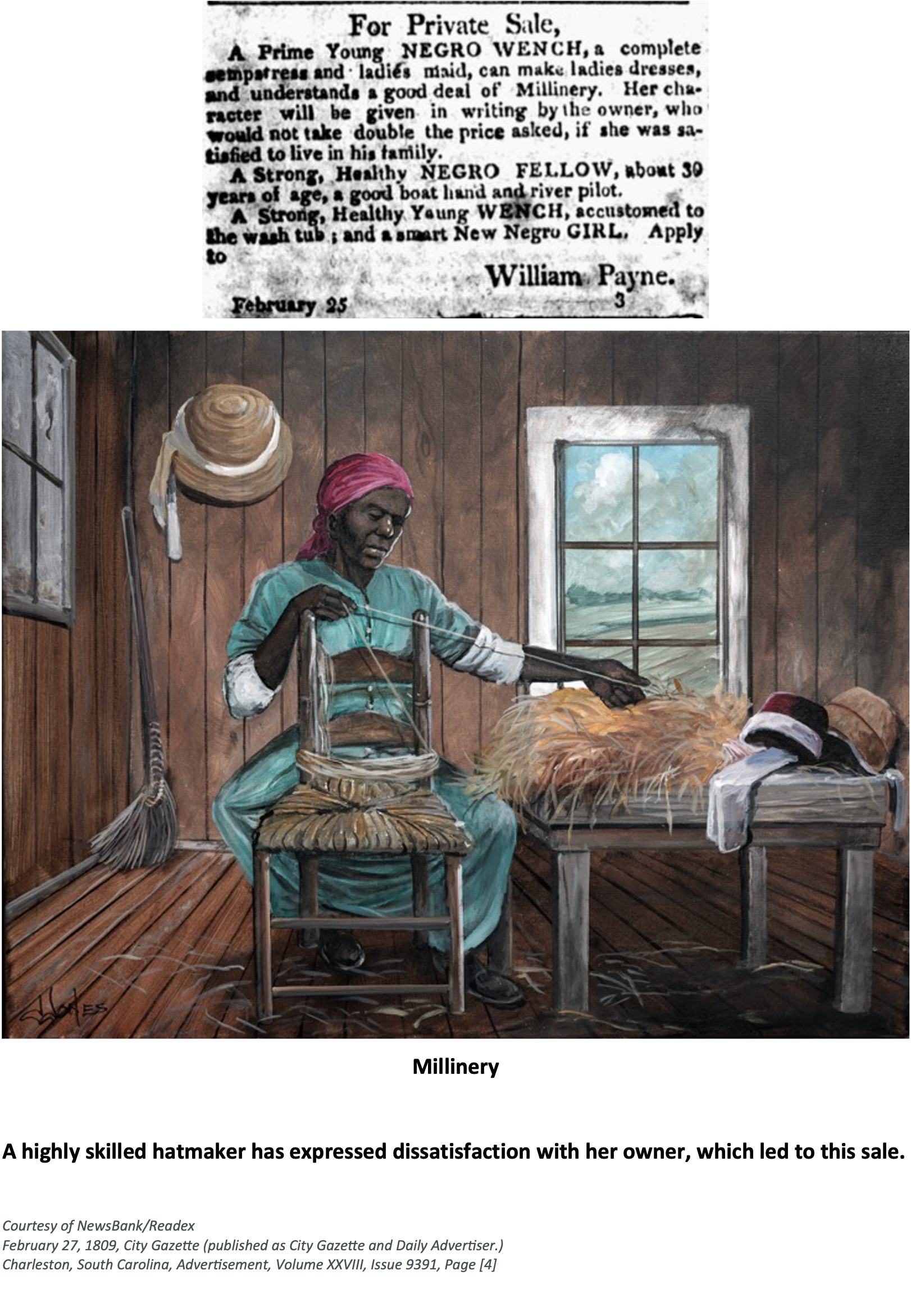
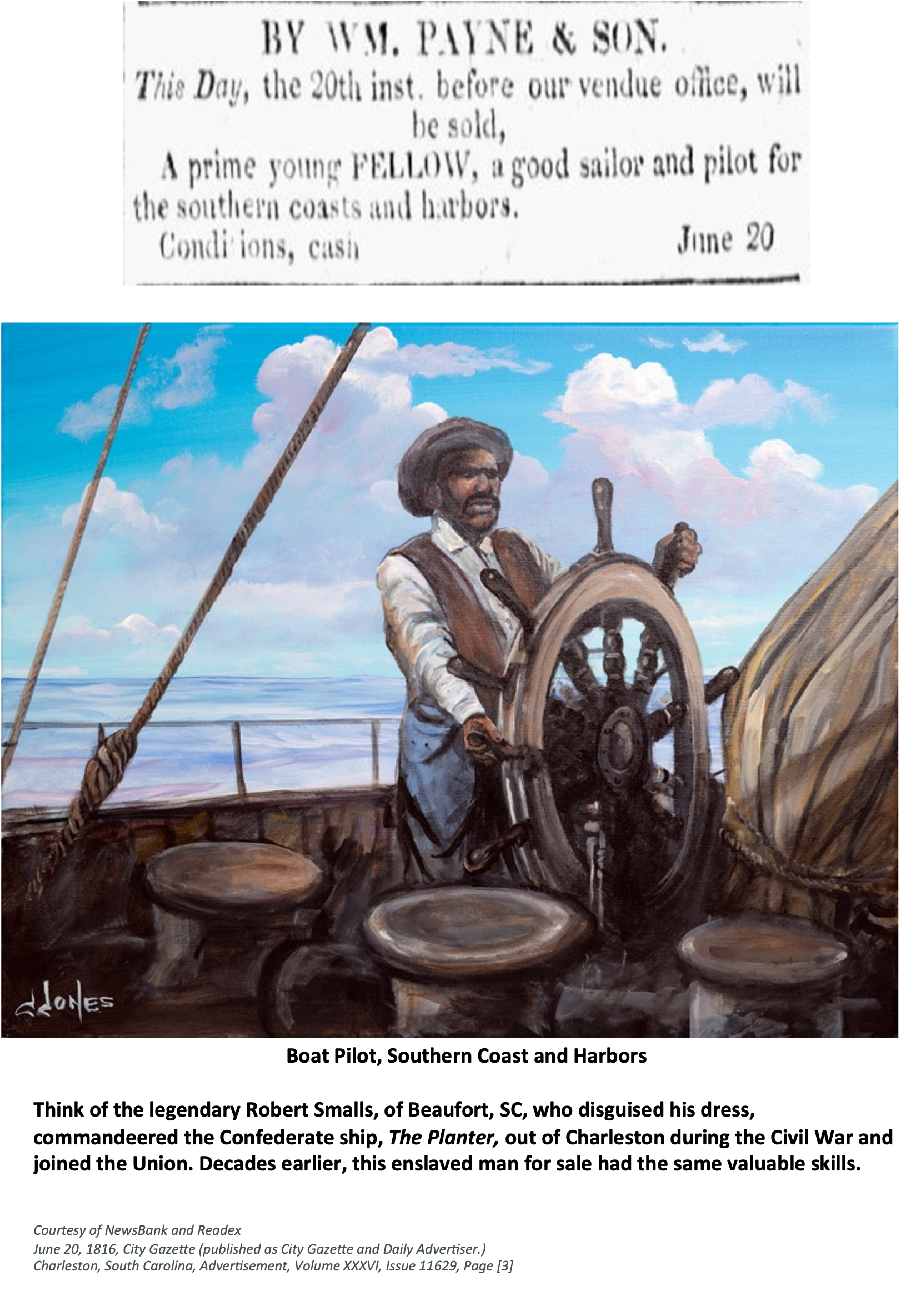
He's an art dealer. He has Gullah Art Gallery down in the Charleston City Market. Known him for years, and he knew about what I was doing with the historic newspaper ads. And he texts me and he goes, "I've got an artist who's interested in your ads. Let's meet." And so we met at the history room at the Charleston County Public Library, and it was John W. Jones from Columbia, South Carolina, Columbia native, and Chuma. And we sat there looking at the ads on my computer for about an hour trying to figure out how could art and these ads come together to really tell a more powerful story. And so for months, I would send ads to Mr. Jones, and he would send me back sketches, and then the historians had me doing research on what the tools would be that the people were using in their occupations that were described in the newspaper ads, where William Payne and his sons were selling them.
-The Research Process
[00:12:51] Margaret Seidler: So it was quite a process. And one of the things that I knew, that everything, from the historians telling me this, and I had some great mentors, Dr. Bernie Powers and Dr. Nick Butler, that everything had to be source documented, and that anything that was the art had to be accurate. It couldn't be where somebody could cast dispersion on its authenticity or accuracy.
And so John W. Jones worked night and day for six months painting from these ads and sending me sketches. Things would get to final and sometimes things wouldn't pass the muster of the historians. We had to take out a church that he had by a barrel maker painting because the church was built, like, 15 years after the ad was actually published in the early 1800s.
We had to take the barbs out of a barbed wire fence. I mean, it was really specific. So just to be clear, Mr. Jones is painting images of what the folks in that ad may have looked like or may have been doing in their work. Right? He brought them to life. He totally brought them to life. And so, so let me, let me just read you an example.
All right, so this is an ad of a, a Negro girl. A Negro is how the enslaved were referred to. A Negro girl for sale. She's a likely Negro girl, about 13 years old of age, brought up in the house, and very handy at housework.
And so what you see is, you see this beautiful young lady. You have a side view of her. She's in the kitchen drying dishes, and she's working in this kitchen where the walls are bright yellow, the curtains are a beautiful rich blue, and she has on a white apron with this amazing purple, beautiful purple shirt on. And she has a serenity in her face. And so what I realized, as Mr. Jones would send me the sketches was that he was bringing them into their own humanity.
[00:15:01] Margaret Seidler: They weren't just black and white pieces of the newspaper. They were real. And I mean, it's just on and on. I mean, there's 34 paintings in the book that are driven by the ads, and then a curation that the historians helped me do to explain the ad. I mean, we have a man who was a brick molder. This means he made bricks for a living.
He's got all his equipment there. He's got these pink colored bricks He also has on a purple shirt. He's got on a hat with a wide brim. He's got dark ebony skin. And as the brick molder, it says, “A man... It's a family of five Negroes for sale. They're going to be sold at the auction block just at the Exchange Building at the corner of Broad and East Bay.”
It's a man and his wife, and their three children. The man is an excellent brick molder, and his wife a field hand. So what we know about the auction block, and what I learned rather, was that likely the family would be broken up and be separated at sale and not ever see each other again. What was so interesting, and what's been so interesting, is we've had an art exhibition for the last two and a half years that's gone around the state as well as down to Fort Lauderdale, Florida.
-Gallery Exhibition
[00:16:17] Margaret Seidler: And the first exhibition was at the City of Charleston's gallery in downtown, about a block away from where a lot of these people were sold on the auction block. So I mean, it's in the place where it happened. And so we had about 150 people come to that first gallery opening, and a lot of them were my friends that I grew up with here in Charleston.
You know, they call me Margie, which if you call me Margie, you got to know me before I was, like, 18 years old. And they came in, and they were, like, looking at these paintings with the ad right there and then the narration, and they were crying. They were coming, people were coming up to me one at a time, and they were crying.
And I'm like, "Okay." I mean, I didn't know people were going to feel this way. They went, "Oh, Margie, I never understood slavery until I could see them." And so what I realized was seeing is believing. Seeing moves us as human beings out of denial. It helps us accept something that has been difficult to even imagine before.
And, and Mr. Jones and I had two ground rules when he did these paintings. They were my ground rules, and he agreed to them. I said, "We will have no shackles. We will have no auction blocks in any of these photos, any of these paintings." And so what he did was he brought to life the people and the many skills that they were using to not only build this community, but to build colonial and beyond in America.
And that is one of the things that I really learned, was that growing up, I was taught that the enslaved picked cotton I didn't know that there were silversmiths and, and, you know, coopers and blacksmiths and hat makers and tanners. I mean, they, they basically did everything that built our community.
Shoemakers, carpenters, cabinet makers, silversmiths. Yeah. I mean, it is just... Boat pilots. I mean, they were out there. Sailors and riggers. I mean, they were out there running the maritime industry. They were constructing the cities And I think that's what's really important that when I talk with people and I show them the book, is that they see not only their humanity, they see their contributions.
[00:18:43] Ame Sanders: Yeah. because a friend and I went to see the exhibition that you guys have. And of all places, it was in the Louise Matheson-Bell Gallery at the Seneca Town Hall. It had been done in partnership with Clemson and Dr. Otis Pickett ...
So the, the comments that you just made were so true for how we, my friend and I, because we talked about it afterwards, how we received that exhibition.
First, it's a pretty large exhibition with a large number of paintings. You have some of them in the book, but there are a lot of them. And it filled the upstairs gallery, and then we went downstairs and we walked in between the offices and we saw more of these ads and these paintings.
And it is truly powerful to see these folks brought to life in the context of the ads right above them. And what you do realize, or what I felt is a little bit of what you were saying a second ago, which is you realize that basically I'm sure there were white people doing work, too, but every single thing that was a piece of labor had Black hands performing it in our Southern world. And that they did everything, as you said, from hat maker to cook to, you know, boat pilot to, I mean- Everything ... everything. And- Everything ... and it was, because it was so diverse and the people so beautifully brought to life, it was really powerful. And I guess it's one of the things I wanted to talk a little bit with you about is I'm not an artist and I've not been a collector or anything, but I find that art touches people in such a different way, that there are many ways into this conversation, but that art strikes some kind of chord or string in people that allows them to open differently and to see differently.
[00:20:54] Margaret Seidler: Well said. Well said. And I don't know what part of the brain it touches. I just know that with the art that people can go deeper and they're not... I, I think it, it does something to lower somebody's resistance to something- Yes ... that's hard. Yes. Yes, yes. And, and it lets them absorb it rather than deflect it.
[00:21:34] Ame Sanders: I think that that is probably what I feel is that when I have... So some time ago, I interviewed some artists, and one of the artists talked about this. And, and having experience now intentionally more art and also in some of the projects I've worked on bringing art to the table as part of that conversation, I think you are absolutely right. I think it does lower our defenses and open us just a little bit so that then we can go somewhere where we would not normally be willing to go, both in our hearts and our thoughts and in our conversation. So, uh, I would say there are images in your book, but also if people have the opportunity to experience the exhibition, it is also quite powerful.
[00:22:05] Margaret Seidler: Just in the scale of it also affects you differently, too, I think. Well, the exhibition has been retired. And the paintings are for sale by Chuma in his art gallery in the City Market. And I'm thrilled to say that the College of Charleston has purchased six paintings, and they'll be in their permanent collection in their Addlestone Library, which is their main college library, which is a hub of stud- student activity.
And in the next few months, I'm sure they'll, they'll go up. I mean, this is just happening right now, and we can't think of a better place for this legacy of this work than the College of Charleston Library. They’ve got almost 20,000 students. And it is going to be front and center, and it is going to be there forever.
And it's going to have the explanation. And it'll have copies of the book, of my book there to augment it. And it will be something that not only students from Charleston but students who come from around the country and around the world will be able to understand where they are and not lose sight of our history.
Ame Sanders: Yeah, that'll be powerful. So it'll be the pictures along with the ads, the whole co- combination. Oh, wow, that's going to be wonderful. That'll be wonderful. On permanent display, that's great. So I, I'm glad that I had the opportunity to see the exhibition then before you guys retired it.
-Polarity Thinking
[00:23:33] Ame Sanders: one of the things, though, that I have to say I'm a little intrigued by is that this is just one step along your journey, and you have a very particular background, professional background. Can you talk a little bit about that for a moment and how it plays into your thinking about this and about how you bring that to this work?
[00:23:58] Margaret Seidler: So about 27 years ago, maybe 28, I was introduced to Dr. Barry Johnson, who was out of Michigan, and he was doing a seminar. My husband and I were living in Minneapolis. I lived there for four winters, couldn't take it, had to come back home. And I was in a class. I was working on a second master's degree, um, this one in organization, organization leadership and development.
[00:24:22] Margaret Seidler: And He talked about complexity, and he said there's some things for which there is an either/or answer, and when that is true, you can just do something and move on. And he said, you know, "The War of 1812 was in 1812. Murder is right or wrong in this country." I mean, there, there's two plus two. I mean, he just gave us all these examples, and I'm like nodding my head, and I'm all excited about listening to him.
And then he goes, "And there are other things that they're not simple either/or answers. They're more complex and more chronic," he said, "like leadership, for example, or living together in a community." And he said, "We call these things polarities, and it requires both/and solutions to manage this complexity and not set yourself up for future unintended consequences."
And I sat there that day, and I mean, I was such a South Carolina girl. Honest, like, I thought about all the people I had fired back in the 1980s here in Charleston because I was a manager. And I realized I fired them because I thought they were all wrong and that it was their problem. And what I realized that what my role was in their not succeeding.
And I told him I was going to follow him to the last day of my life, and I have. So when this happened, and I found out in 2018 that I was related to people who were of African descent, that I have a fifth great-grandmother who's from Nigeria, I realized that I was going to study and make my, the rest of my career for about 20-some years in complexity.
So I specialized in, number one, leadership self-awareness, which is called emotional intelligence, in helping leaders see themselves more completely so their strengths don't become their weaknesses. I worked a lot in conflict resolution, whether it's conflict that two people are having with each other, whether it was a group conflict within a team, or whether it was a group conflict between two different groups.
I mean, I just got on this mission to help people figure out how to deal with hard things. And near the end of my career, I worked in polarizing issues in communities and municipalities pre-predominantly around the country. And so when I started out working what we call polarity thinking 20-some years ago, people's eyes would glaze over.
They wouldn't understand what it is. But today, because we talk about being polarized so much, it makes sense to people that we need to find commonality, that people want to come together as well as things they want to avoid at all costs to get the best of both. Anyway, if anybody could have been better prepared to find out about her family, I, I don't know who else could be better prepared because when you work in conflict resolution, you can't be shy or faint of heart. You just got to be sort of fearless.
And I've used that career in how I address the over 8,500 people that I've talked to in the last two and a half years about my personal research and how I've used it to bring people together and try and bridge the racial divide. And, and what I find is if you're kind to people and you don't try and make them feel bad or shame them, the people are going to be open to hearing what you've got to say.
[00:27:51] Ame Sanders: I agree with you that there's probably-- it would be hard to find someone better prepared than when I heard your career background, it was clear to me that you were well prepared for this to, as you said, deal with hard things and address polarizing issues within a community. I mean, that's exactly what you've been doing with your storytelling, with this book, with these beautiful, powerful images.
It is in fact what you have been doing. So you've continued your work in this way. And, you know, sometimes it feels like right now we have people in our country who are trying to step back from acknowledging our history. And one of the things you said is, "In conflict resolution, avoidance is not a tactic."
So can you just talk a minute about how you think about the current environment that we're living in and where we find ourselves at this moment?
-Bridging the Racial Divide
[00:28:45] Margaret Seidler: Well, I, I'm really glad you brought this up because this is a really salient point for me. I feel that avoidance, it is a choice, okay? It's not an effective choice, not an effective long-term choice. Because when you avoid, it's going to pop up again in another way. I don't know if anybody who's listening has ever played Whac-A-Mole. You whack the mole down, and it comes up in another hole, right? It might not come back up for a day or so, or maybe even a year or ten years. It's going to come back up until the tension gets resolved. And, and that's what is so important to understand is that in order for us to work through this requires us to be what's called collaborative, and being collaborative is the only choice in conflict resolution where it creates a win for all parties, right?
And in order to be collaborative, you've got to both be able to assert yourself and at the same time be appropriately cooperative, right? So if I assert myself and I'm not cooperative, then I'm going to be aggressive and take advantage of you. On the other hand, if I'm overly cooperative and I don't assert enough, then I get to be a pushover.
[00:30:10] Margaret Seidler: So it's this, it's this dynamic balance between those two pieces. And so I look at what's going on in this issue of inequity, in trying to make this a country that, that works for everybody, and that we all have the opportunity to thrive. It may not be the exact same opportunity. We all have an opportunity to thrive And so when I look at it from a Black/white issue, which is really everything I see right now is, is race.
I see Black race, I see white race, and I'm– that's how– that is what I'm focused on. I'm not saying that it's all Black and white, but it's how I'm seeing things. What I see is what's not helpful on the white side is denial and deflection. What I see is not helpful on the Black side is anger and resentment, and that all those have to be dealt with.
We've got to have a way to talk about what are the fears that are associated with my giving up my anger and my resentment? What are the fears that I have of giving up my ability to deny or deflect? because there are some real fears there. And if we can talk about those and find out that we're all just human beings just trying to get through life, trying to get through, because none of us are getting out of it alive, right?
What can we do in the here and now to make this world, this place, this country that's, is so proud of itself, and we have so much to be proud of, what can we do about the parts that we're not proud of and make us all more whole? Give us all an opportunity to work together. And I mean, to me, it's just... It's not easy.
It, it certainly doesn't start with poking anybody in the eye or bullying anybody. That's just not where it starts. It has to start with a softness. And the softness is generally where I can talk about my story, which I exhibit a large degree of vulnerability when I do that. And what I find is, if I'm appropriately vulnerable, which I have a lot of practice at doing over my career, is that ninety-nine point nine percent of the people will come along with me and not attack me.
[00:32:21] Margaret Seidler: So I have to ask people to step into a vulnerability that maybe they've not experienced before and just go with their own pace. I'm not pushing anybody or telling anybody what to do. Just trust me, out of the eight thousand people, they're people doing all kinds of different things that they found out that within their circle of influence, whether it's taking a DNA test, whether it's going to a predominantly Black experience like a church or a, a community event and being a helper rather than an organizer, right?
Stepping out of that role. I mean, one of the things that I really ask people who, who are predominantly white like I am, is to go in a space where you're a minority and just experience what that feels like. I mean, Bob and I-- my husband Bob and I went to a wonderful program Saturday afternoon, and there were about eighty people there, and we were the only white people.
I mean, people appreciate that. We're not in there, like, telling people what to do or being a leader. We're just in there learning. And it's just a cultural difference.
-Individual vs. Community
I mean, if I look at the biggest difference that I see in people of European descent and people of African descent in this country is that people of European descent focus on individual achievements, and that's how we define success generally.
I mean, if you look at corporate America, I worked in corporate America, I know you have, too. That's how it's defined or has been defined. I won't say there aren't teams now, but that's really traditionally how it's been defined. People who are leading our country right now, that's how it's defined for them.
[00:33:56] Margaret Seidler: If you look at the African Americans, they see success coming through community, and those are actually polar opposites, and they're actually needed. It's another polarity, right? So why are people of African descent so attracted to community? Well, if you look at the newspaper ads and you read this book that I wrote about my family's role in slavery, in selling people, you will determine probably, maybe for the first time, understand that community was a way that they survived.
They actually defined family in their community, and they defined family generally very differently than the white landholders because their families were actually being separated. If not dying in their work, they were being separated at the auction block. And so I think that legacy and that what they've learned how to love is through community.
And in the more of the European, my group, we love people who are successful, and they define that as individual achievement. It's just different
Ame Sanders: That actually ties into a lot of the things that I had planned to ask you about. I think you've answered them in that discussion about how we can think differently, how we can come with vulnerability to one another to begin to have different kinds of conversations, find different kinds of answers, and that we, and that denying the past or feeling that we aren't all affected by the past or perpetuating the past is not an effective strategy in any type of reconciliation or solution for us.
Margaret Seidler: So- So just imagine that you are people who are angry and resentful, so you're, you're pushing at the system all the time. So you're pushing, and the people who don't want to have to d- who, and I don't mean consciously, it's uncomfortable, even if they recognize it, to, to deal with it.
They're in denial or they're deflecting. They're pulling back. So you've got a push and a pull, a push and a pull. So it's, there's no coming together. It's just push and a reaction, and if I push or if the African American community pushes so hard and I retreat, at some point I'm going to create systems where their push doesn't make any difference. It's not effective at all. I can insulate them.
Ame Sanders: So in this sort of context and all that we've just been talking about, are you hopeful or not hopeful? Do you think that there is a path to, to healing?
-Hope and Healing are Local
[00:36:30] Margaret Seidler: If I weren't, if I weren't hopeful, I wouldn't be working myself to death at age 74, okay? I know that change is local and that change happens one person at a time, one relationship at a time.
And so for every single person that I talk to, I ask them to look in their own circle of influence and to see. That's how, that's how I met you in Pendleton, was because somebody that I met in Charleston, I asked her what was in her circle of influence. She goes, "Oh, I could have you up in Pendleton." I was like, "Great."
She made it happen, right? Yeah. You made this happen. So it's people seeing... I'm not asking you to write a check or step out of your complete comfort zone. I'm saying what's within your influence? Who can you build a relationship with, right? And so what, what I want In page 107 in my book, page 107 is the most important page in the book, and if I had to do the book over, I would put it somewhere where you don't have to, like, hunt for it.
Ame Sanders: I'm right with you. And don't ask me- I got it marked in my copy, too.
Margaret Seidler: Thank you. And I always talk about page 107 when I talk about the book. It's like, we, we can do this. This is why I'm hopeful. What's going on in national conversations is really important. I'm not going to denigrate that. Change, though, is local.
It's in your municipal areas, in your municipalities, your counties, your schools, your churches, your synagogues, your, um, mosques. And so what I did on page 107 is first I want to honor people who look like me, and I ask them to come with me on this journey, and I want them to open their eyes, and I do not want anybody to poke them in the eye.
Because if I poke somebody in the eye when they're vulnerable, that is it. I want someone to develop trust in what they're doing, to take a calculated risk, and that is by accepting the full history of what has happened as historical fact. Fact is fact. And one thing that I think's important is I want to tell people who look like me that I know they're not responsible for their ancestors' actions, and what I mean is you didn't do it, and at the same time, you're responsible for, what happens now, right?
[00:38:47] Margaret Seidler: You're responsible for what happens now. The past is the past, and the present is the present, and what we do today changes the future for all of us. And I think what's really key, if I was going to have one takeaway, is for people who are white is to try and develop in themselves a newfound empathy, and I think that is the key that happened for me after the Mother Emanuel Church massacre, was I could imagine what it was like, because I worked with some of the survivors in the room, and we're still friends, what it was like to be in that room that night when that young man wanted to start a race war, and he murdered nine people while they were with their eyes closed in a Bible study, right? In the most historic African American church in the South. So I expanded that to an empathy for what is it like for people who grow up Black in Charleston and in America, where their ancestors were subjected to enslavement, and all that that could mean, right?
I mean, there are newspaper ads where several single boys are going to be sold. Now, you imagine if you're a little boy, let's say you're seven or eight, you're sold away from your family, what could that mean for your life? What possible things could adults do to you who owned you legally?
I have another ad where a young boy was a tailor. He literally sewed for a life, right? For a living. And he's 12 years old, and he's been about the business for six years. So I ask people, I say, "If you are a parent or a grandparent, imagine that you have raised your children or grandchildren, and all of a sudden they're stripped from you, and you never see them again. You don't know what happens to them. You don't know what things could go on in their lives." And I think that puts people in the other person's point of view, and it helps explain, as I mentioned earlier, it helps explain the deep connection that African Americans have in terms of community and inclusion.
[00:41:04] Margaret Seidler: And I ask African Americans to get in there, too, because my mother used to say, "It takes two to get in a conflict, it takes two to resolve it." So I ask them to accept, accept my apology, your apology, whoever gives the apology, for what you've had to experience as living Black in America. And one thing that I've heard from my Black friends is they say they want to let go of the responsibility, like they feel they need to educate white people about what happened or what they need.
And just... I said, "Just act as a guide." And then I said, "And let our present actions inform what you do." And I said, "Also, be open to our first steps, because we've got to take the first steps and some well-intentioned missteps. And take a calculated risk with, with somebody like you or me, and lessen any of that resentment and distrust that you have for a better alternative of harmony."
And, and I'll just say this. I'll quote Martin Luther King. He once said, "We may all have come over here in different ships, but we're all in the same boat now." So I think we've talked around this a lot, and those are such powerful things for us to reflect on individually of how we can take those steps.
-Responding to "It's Not Our Problem"
[00:42:20] Ame Sanders: So, so what do you say to people who argue and say that we didn't create the past, so we're not responsible, or it's not our problem, or it's not, it's, it's not for us?
[00:42:32] Margaret Seidler: For me, I want to just say I totally agree with the people who say they didn't create this, it's in the past. That's 100% accurate. They didn't create it, it's in the past, and the past impacts our present. And just as the past impacts our present, we can do things in our present to impact our future. And so yeah, I agree with them.
I did not create any of this, and it is in the past, and we can't separate the past from the present because the past informs the present, and so we can inform the future through what we do today. And so I guess the bottom line is for me, is what I'm asking everybody to do, is to acknowledge historical realities and the consequences of those realities, and figure out what we can do today, do now, to improve this for all of us.
And, and I'm not sure that everybody thinks that way, and I certainly didn't think that way till I got trained in it. Um, I just know that the, the power of it is so great.
[00:43:27] Ame Sanders: It just reminds me that no matter where you start on this journey of becoming a whole community that works for everybody, no matter where you start on that journey where everybody has an opportunity to thrive. We all end up on that journey doing some of our own self work. Either we start there recognizing that we are part of making this work better, or after we work on it a while, we realize we have to work on ourselves in order to move forward.
-Walking the Path Together
It is both. It is an and. I was reading something the other day, and they talked about the journey that you make by walking, that you don't have an end, a complete picture of what the end will look like, but that you create the path by walking it together
Margaret Seidler: Oh, I know that book. It's called Build a Bridge as You Walk on It.
Ame Sanders: Uh, there may be a book that uses that. The one I'm reading is by Rebecca Solnit. It's an interesting way of thinking. To let go of what we think in our mind might be the right answer, and to find the next step and the next step together. And along that way, we, we are changed from walking together. So I think that it's an interesting and challenging thing to do as a community.
Margaret Seidler: It's a great thing to do. I will tell you what you're describing is what we do, and hundreds of us do this.
It's not just Margaret. And I mean, I could keep you on here for hours telling you about all the examples of things that people are choosing to do within their own circle of influence. It is just really phenomenal. People are choosing to make a difference in their own circle of influence.
Ame Sanders: And it is what keeps this podcast going, to be honest, is the opportunity to talk with people like yourself and others who are making a difference in their own community.
[00:45:51] Margaret Seidler: And I guess the, the last thing that I want to say is that this journey has been so liberating for me. If you can only imagine, I don't know if you can imagine, I don't know if you can have empathy for me, finding out that your family brought people in this country on ships, shackled in the bottom of ships, and were wealthy.
They were all extremely wealthy and well-educated, and then they sold close to 10,000 people on Broad Street in downtown Charleston. I mean, I was suffering. The burden was unbelievable. And the only way I knew to pull myself out of that hole, I couldn't pull it out by avoiding it or denying it, because that wouldn't change how I felt, was to get active and figure out compassionate ways to bring the story to the front and center.
And I will tell you, I feel so liberated now. I feel so light. If I die tomorrow, I am good. And that is not how I felt. So if anybody is interested in why it is important to take the relevance of the past with the present and the future, it's about freedom. There's no greater personal experience of freedom than there is the freedom from the shame of the past.
[00:47:17] Ame Sanders: It reminds me of the quote that until all of us are free, none of us are free. That we all need to find that liberation and that freedom from the shame of the past, and together find ways to move forward in the future
-Closing & Resources
Ame Sanders: So Margaret, I just want to thank you so much for this beautiful conversation, for your wisdom and your insight, and for your work that you've been doing to share this with all of the folks that you have. Thank you so much.
[00:47:45] Margaret Seidler: Well, I thank you, and I want to invite everybody to visit our website, where you can see a five-minute video of John W. Jones and me in front of the art exhibit, and see a, a segment that I recorded with Dr. Ben Chavis on the Chavis Chronicles on PBS, and an article in Forbes Magazine. I mean, we really have gotten a lot of support, and it's painfulbusiness.com, P-A-Y-N-E hyphen F-U-L business.com.
Ame Sanders: I'll share it in the show notes, along with some of the images that you've sent me to allow me to share in the show notes so people can see some of the artwork- Mm-hmm, mm-hmm ... and images. So again, thank you.
If you are a part of a book club, I would invite you to ask your book club to read it, and I'm happy to come on a Zoom call and do it with you.
[00:48:33] Ame Sanders: How lovely. Well, thank you.
You know, in today's episode, Margaret could not be clearer about how the past is in the past. None of us here today created the painful past of slavery that she described. However, we all know the past informs our present, and what we choose to do together right now as a community builds our collective future.
There are actions we can all take, large and small, within our own sphere of influence to move beyond our past and build a future that works for everyone, and it takes all of us working together to build that future
This has been the State of Inclusion Podcast. If you enjoyed this episode, the best compliment for our work is your willingness to share the podcast or discuss these ideas with others. If you'd like to hear more about the practice of building an inclusive and equitable community, head over to theinclusivecommunity.com and sign up for our newsletter.
Also, feel free to leave us a review or reach out. We'd love to hear from you. Thanks so much for listening and join us again next time.
CONTRIBUTORS
Guest: Margaret Seidler
Host: Ame Sanders
Social Media and Marketing Coordinator: Kayla Nelson
Sound: Uros Nikolic